Prince Albert in a Can: History, Dating & Values of the Tin
The full story of Prince Albert in a can: where the famous red tin came from, how to date yours, what it's worth, and that old prank call joke.
If you have ever dug through a junk drawer, a granddaddy's workbench, or a flea market bin, chances are you have held Prince Albert in a can. That flat red tobacco tin with the dignified bearded gentleman on the front is one of the most recognizable pieces of American advertising ever made. It turns up everywhere, it has a joke attached to it that most of our grandparents knew by heart, and it is one of the friendliest places to start a collection of vintage tins.
In this guide we walk through where Prince Albert tobacco came from, who the prince on the tin really was, how the designs changed over the decades, how to date a Prince Albert tobacco tin from its markings, what these tins are typically worth, and a handful of ways to put one to work around the house. We have also built a free dating helper you can use right on this page.
What Is Prince Albert in a Can?
Prince Albert is a brand of pipe tobacco that was also sold for rolling your own cigarettes. For most of the twentieth century it came packed in a slim, hinged metal pocket tin sized to slide into a shirt or jacket pocket. The tobacco inside was "crimp cut," a style of cutting the leaf into fine, wavy ribbons that packed easily in a pipe bowl and rolled smoothly into a paper. The tin itself was printed (lithographed) in bold red with the brand name, the portrait of the prince, and the words describing the tobacco inside.
Besides the familiar pocket tin, Prince Albert was sold in larger containers: round and square cans, pound and half-pound tins, glass and metal humidor jars meant to sit on a smoking stand, and later in pouches. When people say "Prince Albert in a can," they almost always mean that classic red pocket tin, but collectors chase all of the variations.
The 1907 Launch by R.J. Reynolds
Prince Albert was introduced by the R.J. Reynolds Tobacco Company of North Carolina in 1907. Reynolds was already a major chewing tobacco maker, and Prince Albert was its push into the smoking tobacco market. Early tins and advertising carry a patent date from 1907, and the brand caught on quickly through heavy newspaper and magazine advertising. Reynolds promoted it as "the national joy smoke," a slogan you will still see on early ads and some older tins.
Prince Albert became one of the best-selling pipe tobaccos in the country and, along with the later success of Camel cigarettes, helped make Reynolds one of the giants of the American tobacco industry. Its long run means that tins were produced in enormous numbers for most of the century, which is exactly why so many survive today.
Who Was Prince Albert?
The gentleman on the tin is not Queen Victoria's husband, Prince Albert, as many folks assume. The portrait is generally identified as Albert Edward, the eldest son of Victoria and Albert, who was known as Prince Albert Edward (or "Bertie") during his long years as Prince of Wales. He became King Edward VII in 1901 and reigned until 1910. He was famous for his love of fine living and good tobacco, so a dapper royal with a full beard made a fitting mascot for a premium smoke. The name honored him as the prince he had been, even though he was already king by the time the brand launched.
Crimp Cut and the "Pipe and Cigarette" Tin
The phrase most people remember from the tin is "Crimp Cut." Many tins read something along the lines of "Crimp Cut Long Burning Pipe and Cigarette Tobacco." That wording matters to collectors because it explains why Prince Albert tins turn up alongside cigarette papers and rolling machines. Before factory-made cigarettes were cheap and everywhere, plenty of smokers bought a tin of crimp cut tobacco and rolled their own. The Prince Albert crimp cut tin was the working man's all-purpose smoke.
The "Do You Have Prince Albert in a Can?" Joke
You can't talk about this tin without the prank call. It goes like this: a kid dials up the corner drugstore or general store and asks, "Do you have Prince Albert in a can?" The clerk, who of course stocks it, says, "Yes, we do." And the kid hollers, "Well, you'd better let him out!" before hanging up in a fit of giggles.
The Prince Albert in a can joke worked because the brand was so common that every store really did have it on the shelf, and the wording of the question sounds perfectly innocent. It became one of the classic American telephone pranks of the mid-twentieth century, right up there with asking whether someone's refrigerator was running. Generations of kids passed it down, and it still shows up in cartoons, comedy routines, and family stories. For a lot of people, the joke is the first thing they think of when they see the tin, even if they never smoked a pipe in their life.
"Do you have Prince Albert in a can?" "Yes." "Well, you'd better let him out!"
Prince Albert Tin Designs by Era
Reynolds kept the overall look remarkably consistent, which is part of what made the brand so recognizable. Still, the tin changed in small ways over its long life, and those details are what help you place a tin in time. Keep in mind that exact dates for every variation are hard to pin down, and reference books do not always agree, so treat these eras as general guideposts.
Early Tins (Around 1907 to the 1910s)
The earliest pocket tins tend to have more ornate detailing, finer lithography, and patent wording printed on the tin. Some early examples carry phrases about the patented process, and early advertising leaned on "the national joy smoke" slogan. The red can look slightly different in tone, and the lettering style is a bit more Victorian. Early tins in good condition are the ones serious collectors hunt for.
Mid-Century Tins (Roughly the 1920s Through the 1950s)
This is the era of peak production and the tins you are most likely to find. The design settled into the familiar layout: red body, the prince's portrait, "Prince Albert" in bold lettering, and "Crimp Cut" wording. Through much of this period, tobacco products carried federal tax stamps, and pocket tins often had a paper revenue stamp pasted across the lid seam. Remnants of that stamp, or a printed reference to the tax paid, are good clues to an older tin.
Later Tins (1960s Onward)
Later tins tend to show more modern printing, simplified graphics, and packaging details that came along with newer labeling practices, such as metric net weights and product codes. Over time, metal packaging gave way to cheaper materials, and Prince Albert moved largely to pouches and other containers.
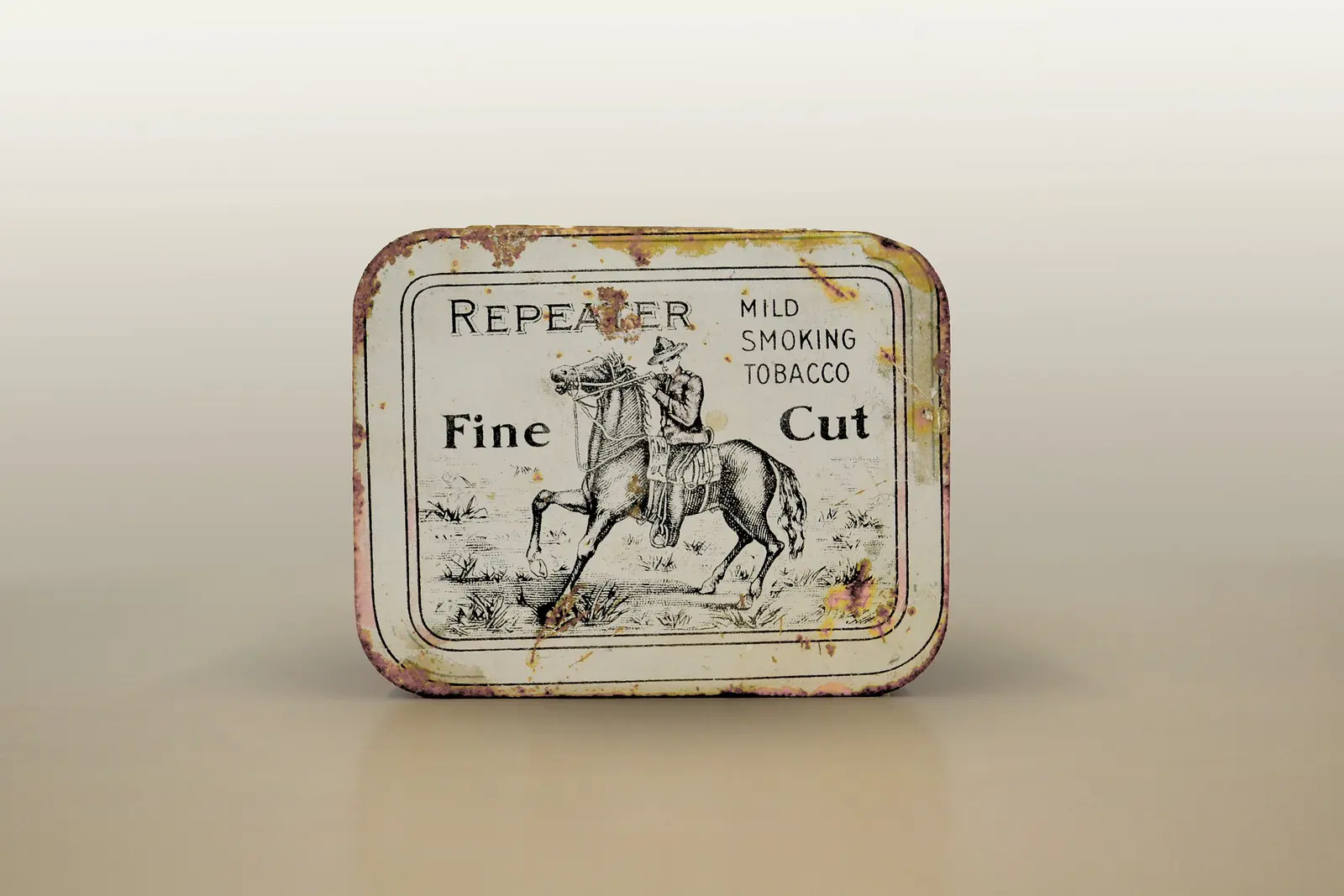
How to Date a Prince Albert Tobacco Tin
Learning how to date a Prince Albert tobacco tin comes down to reading the clues printed and stamped on it. No single clue gives you an exact year, but several together can narrow things down nicely. Here is what we look for.
- Tax stamp remnants. Federal tax stamps were used on tobacco packaging for decades and were phased out around 1959. A tin with a paper stamp, or traces of one across the lid, is very likely from before then.
- Patent wording. References to the 1907 patent or a patented process point toward earlier production, though some wording lingered on the design for years.
- The company address. Look at how the city is printed. The towns of Winston and Salem, North Carolina, merged in 1913. An address that reads "Winston-Salem, N.C." points to 1913 or later. A ZIP code means the tin dates to around 1963 or later, since ZIP codes were introduced that year.
- Net weight markings. Metric equivalents (grams alongside ounces) generally show up on later tins, roughly from the 1970s on.
- Bar codes. A printed UPC bar code points to the mid-1970s or later, when bar codes came into use in grocery and retail.
- Construction. Look at the hinge, the lid shape, and how the seams are formed. Early tins and later tins were made somewhat differently, and comparing yours to a known example helps a great deal.
- Health warnings and slogans. Wording and slogans changed with advertising campaigns and regulations over the years, so any printed warning or tagline is worth noting.
To make this easier, we put those clues into a simple step-by-step helper. Answer a few questions about the markings on your tin and it will suggest a likely date range.
Interactive tool
Prince Albert Tin Dater
Narrow down when your tobacco tin was made from the clues printed on it.
Tick a clue to start
An estimate from printed clues only. Condition, rarity and graphics drive value. See our tobacco tin value guide.
Prince Albert Can Value: What Is Your Tin Worth?
This is the question we hear most. The honest answer is that most Prince Albert tins are common, because tens of millions were made. That's good news if you want to collect them affordably, and a little less exciting if you were hoping to retire on Granddad's workbench tin. Here is how Prince Albert can value generally breaks down. These are typical ranges based on what we see at sales and online, not guarantees, and condition drives everything.
| Type of tin | Typical condition | Typical value range |
|---|---|---|
| Common mid-century pocket tin | Worn, scratched, some rust | A few dollars to around $10 |
| Common pocket tin | Bright, clean, minimal wear | Typically $10 to $30 |
| Early pocket tin with patent or tax stamp details | Good to very good | Often $20 to $75 or more |
| Larger cans, pound tins, and humidors | Varies widely | Typically $20 to $100+ |
| Unusual variations, sample tins, store displays, signage | Varies widely | Can run well over $100 |
What pushes a tin toward the top of its range:
- Condition. Bright color, crisp lettering, no rust, no dents, and a hinge that still works. Collectors pay a premium for tins that look nearly new.
- Age and rarity. Early tins and short-run variations are scarcer than the common mid-century design.
- Original contents or stamps. An intact tax stamp, or a tin that was never opened, adds interest for many collectors.
- Size and form. Humidors, pound cans, and advertising pieces are less common than pocket tins.
For a broader look at how other brands compare, see our guide to vintage tobacco tin values. And whatever you do, don't scrub or repaint a tin before selling it. Aggressive cleaning almost always lowers value.
Prince Albert Cigarette Tins and Other Vintage Cigarette Tins
Because Prince Albert was sold as both pipe and cigarette tobacco, folks often search for a Prince Albert cigarette tin. In most cases they are talking about the same pocket tin of loose crimp cut tobacco, which was used to roll cigarettes by hand. Prince Albert's strength was loose tobacco, and that pocket tin is what collectors associate with the brand.
If you enjoy Prince Albert, you will probably enjoy vintage cigarette tins in general. Before soft packs took over, many cigarette brands were sold in flat metal tins holding fifty or a hundred cigarettes, and some were packed in round tins as well. These flat tins were popular in the first half of the twentieth century, including tins made for overseas troops and travelers. They make a natural companion to a Prince Albert collection, and they display beautifully side by side. Other popular categories include:
- Pocket tobacco tins from competing pipe tobacco brands, often in vertical shapes with colorful graphics.
- Flat fifty cigarette tins, the slim rectangular tins that held fifty cigarettes.
- Lunch-pail tobacco tins, larger tins with handles that were reused to carry lunch.
- Roll-your-own accessories, such as cigarette paper booklets and small rolling machines.
As with Prince Albert, condition is king, and graphics that are bright and unscratched draw the most interest.
Finding and Repurposing Prince Albert Tins
Where to Find Prince Albert Tins
The good news is that these tins are still easy to find. Some of our favorite hunting grounds:
- Estate sales, especially in garages, basements, and workshops. Old tins were reused to store screws, nails, fishing tackle, and buttons, so check the shelves and drawers. Our estate sale tips cover how to shop them well.
- Flea markets and antique malls, where tins often turn up in booths of advertising and "smalls."
- Farm and barn sales, where tins have often sat untouched for decades.
- Online listings and auctions, which are handy for finding specific variations, though you should look closely at photos and ask about condition.
Watch out for reproductions and modern novelty tins. If a tin looks too bright, too perfect, and too cheap, compare it carefully to a known original. The lithography, the weight of the metal, and the hinge construction often give a reproduction away.
Repurposing Ideas for Old Tobacco Tins
A worn tin that isn't worth much to a collector can still be a charmer around the house. Here are a few ways we like to use them:
- Sewing kit. A pocket tin is the perfect size for needles, a few spools of thread, and a thimble.
- Workshop organizer. Label a row of tins for screws, picture hangers, and drill bits.
- Tiny planter. Add a few small succulents with gravel in the bottom for drainage.
- Gift box. Tuck a pair of earrings or a gift card inside a cleaned-up tin for a vintage presentation.
- Shelf display. Group tins by color on a narrow shelf or in a shadow box for a bold advertising wall.
If a tin has surface rust, take a look at our guide on how to remove rust from vintage metal before you start. Use a gentle approach and test on the back first. If you plan to use a tin for anything food-related, line it, because old tins were never meant for food storage once they've been used.
Is Prince Albert Still Made?
People often ask when did they stop making Prince Albert in a can. As best we can tell, Prince Albert pipe tobacco is still sold today, though the brand has changed hands since the R.J. Reynolds days and it is now generally sold in pouches and other packaging rather than the classic metal pocket tin. The metal pocket tin was phased out in favor of cheaper packaging somewhere in the later part of the twentieth century; sources differ on the exact year, so we can't give you a precise date with confidence. What we can say is that if you are holding a metal Prince Albert pocket tin, it is a genuine piece of the brand's past.
Whether you keep one on a shelf for the memories, line them up for the color, or start hunting early variations, Prince Albert tins are a fun, affordable way into collecting. Browse more of our vintage finds for your next treasure hunt.
Frequently asked questions
What is Prince Albert in a can?
Prince Albert is a brand of crimp cut pipe and cigarette tobacco introduced by R.J. Reynolds in 1907. For most of the twentieth century it was sold in a flat, hinged red metal pocket tin, which is what people mean by "Prince Albert in a can." The tins are now popular, affordable collectibles.
What is the Prince Albert in a can joke?
It's a classic prank call. A caller asks a store, "Do you have Prince Albert in a can?" When the clerk says yes, the caller replies, "Well, you'd better let him out!" and hangs up. It worked because nearly every store really did stock it.
How can I tell how old my Prince Albert tin is?
Look for clues like a paper tax stamp (generally before about 1959), patent wording, the "Winston-Salem" address (1913 or later), a ZIP code (around 1963 or later), metric weights, and bar codes (mid-1970s or later). Several clues together give you a reasonable date range, and our Prince Albert tin dater walks you through them.
How much is a Prince Albert tobacco tin worth?
Most common pocket tins typically sell for a few dollars up to around $30, depending heavily on condition. Early tins, larger cans, humidors, and advertising pieces can bring more, sometimes well over $100. Bright graphics and no rust make the biggest difference.
When did they stop making Prince Albert in a can?
The classic metal pocket tin was phased out in the later part of the twentieth century, though sources differ on the exact year. Prince Albert pipe tobacco itself is still sold, generally in pouches and other packaging rather than the old metal tin.
Who is the prince on the Prince Albert tin?
The portrait is generally identified as Albert Edward, Prince of Wales, the son of Queen Victoria and Prince Albert. He became King Edward VII in 1901 and was known for his love of fine tobacco.